On LOVE:

“The most important aspect of love is not in giving or the receiving: it’s in the being. When I need love from others or need to give love to others, I’m caught in an unstable situation. Being in love, rather than giving or taking love, is the only thing that provides stability. Being in love means seeing the Beloved all around me.”

(courtesy of Ram Dass). 

tree.gif

Just like you. 

When I began my journey as a business coach ten years ago, I was excited about the idea of giving advice and direction to fellow creatives who were seeking success and prosperity. Being that I’ve had a gift for marketing and communication, it was a natural next step for me to take after selling my design firm. 

What I quickly discovered was that most of the business challenges that people were having were personal problems in disguise. It wasn’t that people didn’t know what to do. There was plenty of information out there on how to grow a business and how to market. What was present with everyone I was coaching was fear. The voice of fear was leading their lives and the choices they were making were not aligned with their authentic selves. People pleasing was rampant and there was very little self-love present. 

Self-love? What does that have to do with running a business, you may ask?

Well, everything. 

Everything stems and gets created from the way we love ourselves. 

When we love ourselves, we make choices that are healthy for our growth. We don’t compromise our talent, we aren’t afraid to ask for what we want and we experience a level of self-confidence that allows us to be truly creative. That also influences the people we attract. The clients that hire us. The employees that want to support us. 

 Teaching people how to better love themselves has become a core theme in my coaching work. This is the hardest work for people to do. Doing self-love work means that we are required to face our dragons and heal our wounds. That’s a scary space for most people. But it’s work that changes everything. Everything. 

Last weekend, for three days at Joshua Tree I became a student again. I attended the Human Awareness Institute’s workshop on self-love and learned from highly skilled masters about how to bring more love and intimacy into my life. Leading edge work, unconventional exercises and powerful insights helped me get healthier and more aligned with my higher self.  This was hard work at times. Scary. Surprising. Challenging. But so worth it. Here I was with forty fellow men and women, naked the entire time, facing our inner dragons and liberating from old ways of judging and seeing ourselves. 

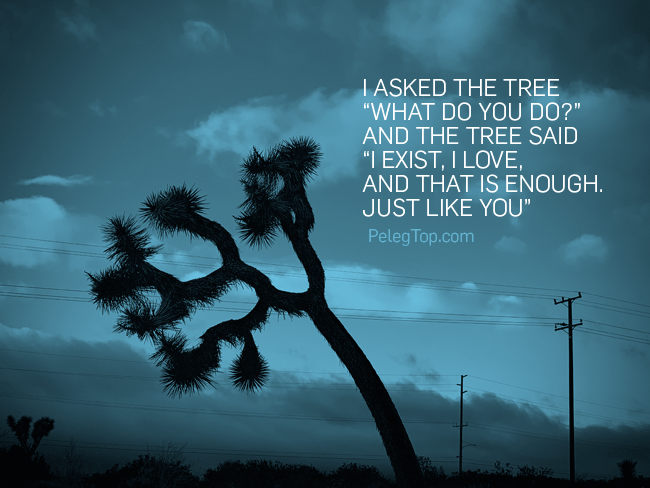
One evening, while soaking in the outdoor hot tub of the retreat centre,  I looked up at a Joshua Tree nearby, as he stood tall against the landscape of electric wires, these words came forward:

I asked the tree
“who are you?”
and the tree said
“I am one of
God’s creations.

Just like you.”

I asked the tree
“What are you?”
and the tree said
“I am what I am. 
Just like you.”

I asked the tree
“what do you do?”
and the tree said
“I exist, I love,
and that is enough.
Just like you”.

away.gif

Coaching advice:
Taking a personal retreat


Dear Peleg,

My wife and I own and operate a design firm together. After years of having the business lead the way we are struggling with defining what we want out of life, and in turn, our business. I’m planning to schedule an out-of-town retreat for us to relax and make space to define what we want or at least let our mind go to those places. I was wondering if you can give us any tips to make the retreat most effective and if you have any exercises, worksheets or any tools we could use in this process?

Charles
(Denver, Colorado) 


Dear Charles,

Taking regular personal retreats is one of the best habits you can develop to ensure the health and well being of your business. A personal retreat allows you to gain perspective, prevents stagnation and get clarity on what you want out of life.

When running a business, it’s easy to get sucked into the day to day tasks and become distant from the big picture of why you are actually in business or what goals you want to meet. Stepping away from the every day helps us gain the insight and perspective we need to make necessary changes, improve things or make the big decisions we need to make but never take the time to focus on them.

Here are a few tips on how to make the most from taking a personal retreat:

1. Create the right environment. Where you hold your retreat is a crucial part of setting the stage. Your environment will always influence and create your experience so choose a location that allows your heart to expand and your mind to quiet down. I personally like to splurge when I take retreats and choose locations that inspire me, speak to my design senses and lift my spirit in a creative way. There are amazing resorts and retreat centers around the country that could be a perfect fit. Choose a location that is out of town, somewhere that you will really feel like you are away from it all. Look for total comfort so that all your basic needs are being taken care of. This includes super comfortable sleeping accommodations and healthy food to nourish your body.

2. Avoid alcohol. It may sound like fun to bring a few bottles of wine or the makings of your favorite cocktails but including alcohol inside of your retreat experience can potentially get in the way of the clarity that you want to receive. Let’s face it, the short-term effects of alcohol can bring on drowsiness, headaches, impaired judgment and decreased perception. Avoid anything that could get in the way of having a clear mind.

3. Truly Unplug. Seriously. Be unreachable for the time you are away. Make any necessary arrangements to protect this time from distractions. Go offline and go inwards. Having ongoing input from outside sources can disturb your process and interrupt your flow. This is not easy for most people to do and will require some self-discipline on your part but trust me, it will be worth the effort.

4. Give it time. Don’t try to rush the process. Schedule at least three nights so you are able to gently enter your process and not rush towards an outcome. If you can take a week away, even better. Allow for time to slow down enough so that you can begin to hear your inner voice loud and clear.

5. Set an agenda. You want your time to be most productive, efficient and well planned. I always like to create a loose schedule on how I will spend my time. I allow time for meditation, walks in nature, meals, work sessions and of course, rest. Figure out what can help you to make the most out of the experience and build it into your day.

5. Allow time for nothing. In your retreat schedule, allow blocks of unplanned time so that if the muse appears you are able to answer. Perhaps you will feel like making some art or reading. Or perhaps a nap would serve you well.

6. Self-care. Improving your physical state can be a direct outcome of a personal retreat. Take time to maximize the health benefits your location can offer you. Book a massage treatment or go for a swim. Include some kind of bodywork that can help you get out of your head for a while.

7. Set your intentions. Consider what the purpose is for your retreat. What are you hoping to receive from this time? Is there a burning question that you want answered? The clearer you are, the more you will be receptive to change — the results you are looking to get. It is like preparing the soil. By setting up clear intentions you eliminate wondering and confusion while in it.

8. Follow a process. Depending on the outcome you want from your retreat, following a guided process can support you in the most effective way. One of my favorite tools for exploring your future is The Personal Compass from Grove Consultants.  I also like to come up with a set of questions I want to be answered in advance of the retreat. Thinking of these questions sets up my mental state to be open to receiving the answers.

The biggest changes I’ve done in my life and my business came out of decisions I made when taking personal retreats. Taking time away for a personal retreat is a discipline that not many professionals take seriously enough. However, it is during those breaks in our routine that we discover what really matters.

content-line.gif

If you have a burning question you would like some coaching advice on, send in your
question via email to advice@pelegtop.com


Is happiness a myth?

“Let me tell you something, happiness is bullshit. It’s the great myth of the late twentieth century. Do you think Picasso was happy? You think Hemingway was? Hendrix? They were miserable shits. No art worth a damn was created out of happiness, I can tell you that much.

Ambition, narcissism, sex, rage, those are the engines that drive every great artist, every great man. A hole that can’t be filled.”

                - Ed Harris, from the movie Kodachrome (streaming on Netflix)


I’ve been in an ongoing conversation about happiness lately. It seems that everyone has a different definition of what happiness is or isn’t.

The other night I was watching the movie Kodachrome, now streaming on Netflix. One of the main characters in the movie, played by the brilliant Ed Harris, is Ben, a cancer-ridden, dying photographer who claims that happiness is bullshit.

He states that no art worth a damn has ever been created out of happiness. He suggests that great artists are driven by pain, addiction and a “hole that can’t be filled”.

Is it necessary to be miserable in order to tap into our creative genius and make great art?

Must we be melancholy to be better artists?

I don’t believe so.

Great art has indeed come out of deep pain and suffering and for many artists, that dark space can become a path to one’s tragic demise. Think Vincent Van Gogh, Mark Rothko or Ernest Hemingway to name a few.

So many of the great artist we know were lonely, compulsive and self-loathing. They were trapped in fear mode and came to believe that their creative output was dependent on their misery. They may have found solace in their art, a temporary escape from their dragons, but they kept choosing to stay unhappy.

Imagine if these artists healed their wounds and lived their lives from a place of self-love and self-worth?

Imagine if they chose to be happy?

Happiness is a choice and if you choose to be unhappy, you will be unhappy no matter what it is you do. Many artists prefer to stay unhappy of fear that their desire to create will disappear with happiness. So they stay stuck inside their self-loathing, fear-based world, and take no steps towards healing their wounds. They prefer to numb the pain with alcohol, drugs or sex believing that their pain is the source of their creativity.

Healing our wounds can be a scary space to enter. But unless we face our dragons, we may never meet our angels.

If I met Van Gogh today, I would more than anything love to wake him up to his true creative genius, beyond the canvas. I would love to teach him how to love himself so that his life becomes the canvas of his creations. So he would feel self-worth and confidence to pull himself out of poverty and live a prosperous life.

We can be happy and be great artists. Don’t believe the myth.

star.jpg

Here's the full trailer to Kodachrome. Highly recommended movie to watch. 

yoda.gif

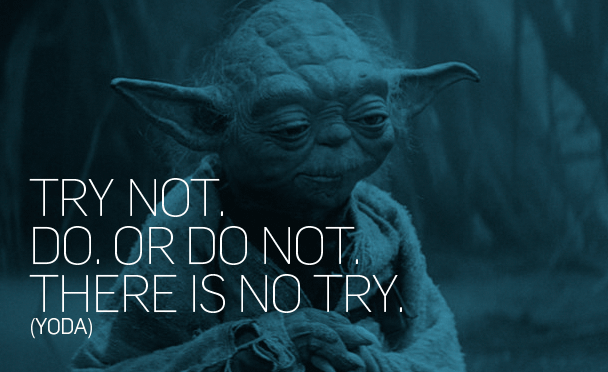
Why trying leads nowhere.  

Last week I met with a new prospect who was interested in hiring me as his coach.

“I’m trying to grow my business,” he said, “and I’m not having any success. After fifteen years I’m feeling trapped, frustrated, and depressed”.

When I asked him to describe how he markets his business or how much time he invests in business development activities, he couldn’t give me a specific answer. His marketing activities were random, reactive and unfocused.

I wasn’t surprised to hear about his lack of success because he told me, in one word, where his mindset is about his business.

He told me he was “trying”.

Whenever I hear someone tell me that they are trying to do something, what they are actually telling me is that they are simply interested in the idea of success but they have yet to commit to doing what it really takes to get there.

If this person was truly committed to growing his business he would have shown up differently to it.

I asked him to open up his calendar and count the number of hours he allocates in the last month to marketing and business development activities.

You can guess what his count was.

Zero.

I’ve come to believe that there are two types of people in the world. People who try and people who commit.

People who try often complain, cling to excuses and give up on their dreams too quickly. They put off doing the things they know they need to do and allow distractions to pull them away from their goals.

People who commit bring a different mindset to their lives. Their commitment shows up as activities on their calendar.

If this prospect was really committed to growing his business, he would actively schedule marketing and business development activities on a weekly basis. He would stop trying and start doing.

When we get comfortable with trying, even for a bit, we open the possibility of failure and give ourselves an out.

“Try” is a worthless word that accomplishes nothing. It might make us feel better when we fail, but it actually encourages behavior that leads to failure.

I told this prospect that in order for me to coach him, he would have to stop trying to grow his business and commit to doing the work it takes to achieve his goals. When I spelled out to him exactly what that would need to look like, I could tell that he felt a bit intimidated hearing what a commitment to growing his business means and that he wasn’t really interested in doing the work.

The reality is, when we really want something, we simply do what it takes to make it happen. And if we hire a coach to support us, the coaching process serves us inside of our creative process. If you don’t want to do something, fine. Don’t do it. But don’t pretend that trying is the same as doing. They are two completely different mindsets.

This person reached out to me thinking that coaching is the answer to his business problems. But from my experience, coaching only works when a person is excited about what they want to create. When you bring a commitment to creating yourself, having a coach by your side will expedite the creation process and move you forward towards your goals because they show you where your blind spots are and help you see the path more clearly.

The more we talked the more it became clear that this person felt stuck in his business and was not feeling fulfilled by the work anymore. What motivated him to stay in business was the responsibility he felt towards his employees and not the joy of the work. His lack of success wasn’t because of his lack of trying but because his heart wasn’t in it anymore. He was just too afraid to admit it to himself. He was denying his heart’s desire hoping that hiring a coach would magically transform his business. In reality, no coaching can motivate anyone to do something their heart isn’t devoted to.

When our heart isn’t leading the way in anything we do, the challenges we encounter along the way can easily bring us down and make us feel defeated. We can feel unmotivated and lost. But when we’re heart-driven, when we do something because we want to (not because we feel like we have to), challenges become a source of strength. We embrace them and welcome the opportunity for growth.

This person realized that he was using “trying” as an excuse to not look at the real reason his business is suffering. For the first time, he was willing to embrace the fact that it may be time for him to exit and begin a new chapter in his life.

He began to get excited about what’s possible for him. He began to see how his commitment to exiting his business could open up new opportunities for him. He didn’t let his fears lead the way but gave himself permission to dream.

I assured him that coaching him from this space would be more valuable and effective and, as his coach, I would guide him through that process. From that place, real creation can happen. There will be no trying involved, only doing to move his life forward in the direction his heart desires.

A trying mindset leads nowhere. It is doubt-filled, skeptical and low commitment. Saying “I’ll try” is like admitting upfront that you quite likely will not be doing that thing.

If there’s an area in your life that you feel like you are trying and not succeeding, take a closer look at the real reason why this may be occurring. It could be that whatever it is you are trying to do, isn’t what your heart really wants you to.

« Previous123456...11Next »