
Blog-Emma-header.jpg

How to choose the right clients.

Your business is no business if it has no clients who pay you for your work. And the kind of business you have ­– how enjoyable and profitable it is – depends more on who your clients are, and less on how good you are at what you do.

Your clients shape your business.

A client is a person or a group that uses your professional advice or services and is willing to pay for them. The kind of client that you take on will determine the real success of your business.

Most people say “yes” to any client with a checkbook. That’s because most people operate from a place of fear of going out of business. They put very little time or energy in assessing if the client is a good client for them. Often times they discover that the client with that huge budget turned out to be a nightmare to work with.

That’s not healthy. Not for you and not for your business.

Unless you take time to identify which client is calling you to serve them, you are bound to take on the wrong client and get yourself in trouble, yet again. It’s easy to be seduced by big name clients with big budgets and fame-promising projects.

Nevertheless, beware.

You owe it to your business to choose the right clients. When you do, and I’m sure you’ve experienced this at some point, there is a healthy flow to the work, the client does not question your fees and the whole experience of working together is joyful throughout. Plus, you will always do your best work for the right clients.

When you work with the right client, you are free to truly be the creator that you are. Your work, your choices, your ideas aren’t questioned or challenged. Your client trusts you and, they will most likely be back for more work and happily refer you to their friends and colleagues.

I’ve served clients for over 25 years and one thing I found in common, in both my career as a designer and in my current work as a coach, is that there are only two types of clients out there.

There is the “save me” client and there is the “lead me” client.

The “save me” client is operating from fear. They like to be in control, they want to call the shots and they want to hire you to be an order taker. They want deliverables. They want to hit certain goals. And they want you to help them look good.

The “save me” client has very little integrity. Often times, they don’t stick to agreed deadlines, they change the scope of the project mid way, and they expect you to be at their beck and call. Their world is usually a mess. They are unorganized, unprepared and are more concerned with looking out for themselves.

They will be late for meetings, not pay you on time (or sometimes not at all), they will abuse and disrespect you and will quickly drain your time and profits.

The “save me” client is bad news. They aren’t willing to take responsibility for the mess they created in their business and look for someone (you) to fix things for them.

I can’t tell you how many businesses I’ve coached that are used to having this type of client as the norm.

Then there’s the “lead me” client.

This is the client who is smart enough to know where their limitations are and when to hire a professional to help solve their problem and lead them towards a solution.

They are opened to be lead because they trust you. They see the value you provide and are willing to let you do your magic. They believe in your vision. They respect your opinion. They allow you to do your job.

A “lead me” client has high integrity. They operate from a place of commitment, good communication and trust. They will allow space for questions, they pay well because they know you are a valuable asset to their success and they allow reasonable time for the work.

They are more concerned about finding an expert they can trust than getting the lowest bid. They are willing to listen and take advice and have a single point of contact that actually has the power to make decisions. They participate in your process, but not too much. They allow you to lead the way.

Imagine if every one of your clients was a “lead me” client. What would your business look like? Where would your stress level be?

Knowing how to identify if the prospect whom you are talking to is a “lead me” or “save me” client is crucial. You need to learn to identify the red flags early on. You need to know which questions to ask and listen not only to what the answers are but also to how they are being delivered.

This is a skill that takes time to develop.

But that’s not enough.

Attracting a “lead me” client also requires smart positioning and authentic marketing. Without those, you will spend more time saying “yes” to the wrong clients more often. If your business is attracting more “save me” type clients, your current positioning and marketing is failing as well as the language you use and the way you show up.

You are the creator of your clients.

To attract more “lead me” clients you must lead first.

You must put your best self out there and value your work in a way that projects confidence and trust. If you are operating from a place of fear and low self worth, you will attract the kind of clients that respond to that.

Being a leader in your business means that you are willing to say “no” when you identify the wrong client for you. It means that you don’t compromise yourself. That you respect your work enough to walk away from what may seem to be a good opportunity if it comes from the wrong source.


Image: © 2015 Peleg Top
honor-bird.jpg

Say yes to the mess.

We all go through periods in life when things are a bit of a mess.

When I say “mess”, I don’t mean the mess you’d see on a typical reality show where people’s lives are totally out of control.

The mess I refer to is the time when we go through significant changes.  When we lose what appears to be our “everything” and we don’t know what to do next.

For some it could be a loss of a job or a major client. For some it could be a loss of a relationship. Whatever the mess is, it is generally filled with fear of the unknown, self doubt and worry.

How you manage yourself inside this mess depends a lot on your inner strength and your ability to cope with the unknown. If you are not trained in how to handle anxiety, how to live with ambiguity, and welcome patience — you won’t be able to flee from this terrible “cloud of unknowing.”

This space is often referred to as a “liminal space”. The in-between space. Where you’ve left the tried and true and haven’t yet been able to replace it with anything else. When you are between your old comfort zone and the newness of what’s to come.

The liminal space is where transformation takes place.

When we learn to allow this space to exist, we can experience tremendous self growth.

But most of us are afraid of this space. We avoid it.

We compromise our lives, our relationships, and the things that really matter to us just so we don’t have to go through the pain of living in the unknown.  

The liminal space is a waiting space. It can actually be the most important time in your life if you allow it to be. This space has power and gifts.

Our life can seem like a mess during this time, but if we simply say yes to this mess, if we allow ourselves to be just a bit out of control of needing to know how things will resolve, we can tap into deeper inner wisdom.

I suspect I’ve become an expert at living in this liminal space.

I’ve experienced it twice in my life. First, when I decided to sell my design firm ten years ago, not having any idea what I wanted to do next. And then more recently, a divorce that prompted a two year journey around the world where I went soul searching for who I wanted to become.    

As romantic as traveling the world may sound to you, this space was not an easy place for me to live in. It was hard, dark, and often times, a lonely space. I had to allow myself to be drawn out of "business as usual" and remain patiently on the "threshold”.

I’m the kind of guy that is used to being in control of his life. The master of his own destiny. And here I was traveling from country to country, having to give up control of knowing what’s going to happen next. There were days where I had no idea where I would be sleeping next or how I would be getting to my next destination.

But as hard as some of those days and nights were, I had faith. I knew that being inside this space, allowing the mystery to unfold, would only lead me to where I am supposed to be.

I knew this because I know the value of deep inner work.  

That’s why I kept saying yes to the mess.

I said yes to healing my grief, yes to facing my fixations, and yes to knowing my shadows, all of which I avoided for so many years.

And the results?

Miracles. My life is in the best place it has ever been and my work is feeling more powerful than ever.

A liminal space is unavoidable. And often times, we aren’t aware that we are in it. However,  if you are willing to wait and not run away from facing your mess, I can promise you that the inner work you will do during this time will transform your life and lead you to a bigger, better place.

Photo: Santa Fe Sky © 2014 Peleg Top 


Forget about your process

process.gif

If you think that your clients care about your process, or value you having a process, or if you think that displaying your process on your website will justify stronger positioning and lead to higher fees, think again. Your process is not a business development or a marketing tool.

Many design firms (and design firm owners for that matter) spend way too much time trying to define their process and then use that process as a business development tool or as part of their marketing. If you looked at ten agency websites and compared their process side by side you wouldn’t find too much difference in how they do what they do, but would find sophisticated words describing each part of their process. 

Don’t get me wrong. I am not advocating that your process isn’t important. It is important and should be well defined. But your clients really don’t care about what your process is. Only you do. 

If I was going to eat at a high-end restaurant, famous for its chef-owner, do I care about his process? Not really. What I care about is how the food is going to taste once I bite into it. The chef can have the most defined process of all chefs but if his food doesn’t make me feel like I’m falling in love every time I bite into it—the process is pretty much meaningless. 

You are the famous chef of your agency. Your process is how you do what you do and your focus in getting clients to come through your doors is not to tell them how you cook but to let them taste your food. 

What does your client care about? Themselves and their success. The problem is that your clients generally don’t really know what to look for in a design agency so they sometimes will ask you to tell them about your process. Don’t fall for it. They really don’t care. If a client asking “what is your process?” they are really asking “tell me what my business will look like after we work together.” 

Your process is different for every one of your clients because every one of them is different. You’re not selling cookie cutter creativity, you are selling focused attention and guidance that is individually tailored to each of your clients. Don’t confuse your process with the stages of your work. The stages may be similar but your process isn’t.

When you meet with your prospect for that pitch meeting, don’t lead with your process. Lead with asking as many questions as you can so you can find out where your clients want to go. The more questions you ask, the more clarity you will gain on what process would work best for your client. Talk about results. Paint a picture to your client of what their business can look like after you’ve worked together. Get them excited and enrolled in working with you. 

Focus on the benefits and results of working with you, and you won’t need process to convince the client to make the decision to hire you. Show them what’s possible—and how your creative thinking can take them where they want to go.

The most successful marketing tool my design firm ever had.

The year was 1993 and I was a young designer, eager to succeed and hungry to grow my design firm. But I was feeling stuck and scared.

It was painful to even flip through the pages of any graphic design annual. My self-critic would always kick in and all I would be thinking of is how much better everyone else’s work was than mine. By the time I put the magazine down, I felt frustrated knowing that I wasn’t marketing my firm well or creating any special self-promotion pieces that were winning me clients—or awards. That frustration led to shame. And the shame would stop me in my tracks.

In search of direction, I attended my first HOW Design Live conference, and I walked away with two very important insights: without marketing, my business had no serious future; secondly, the essence of marketing is to stay in conversation with your clients and prospects. 

I returned to my studio with a simple self-promotion idea that would become the pillar marketing piece for my company for the following 14 years. As my business was just starting, I didn’t have a budget to devote to marketing and there were a lot of people I wanted to stay connected to. So I had to get creative. I approached the local print shop that was printing most of my work (in those days printing was a major expense for every design firm) and convinced them to trade services to create a joint marketing piece we both could use. The printer jumped on the idea and we became each other’s marketing partners for years to come.

We created a calendar to send to our clients and prospects. But rather than send it all once, with the entire year bound together, we sent a single sheet each month, to create 12 points of communication instead of just one. It was important for me that the piece had value and that it wouldn’t end up in someone’s trash bin after they received it. So it had to be useful, it had to be beautiful and it had to be on time. I often used to joke that our calendar sheet was the only piece of art some of my corporate “suit” clients would have in their office.

The calendar was a hit with the people who received it—to the extent that they’d ring us if they missed a month, asking what had happened to it. The calendar was a true promo piece as it demonstrated what to expect from working with us: loyalty, consistency, expertise in marketing and our personal approach to developing business. It kept our clients and prospects connected and happy to hear from us.

There was a lot of love put into every single mailing, from the overall design to the handwritten addresses on every envelope to the love clients felt when they received it. This was definitely a “love-creation” piece.

The simplicity of this marketing piece and the intention in which it was sent supported an ongoing conversation with our clients and prospects. The calendar, which we mailed every month, was by far the most successful and cost-effective promotional piece our studio produced in a span of 18 years in business.

ENRich-retreat.gif

“Stepping back from the day-to-day business activity refreshes your brain, offers fresh perspectives and opens your mind to new ideas and creativity.”

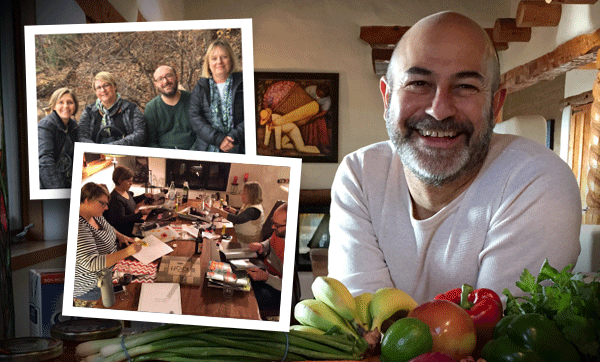
Last month I had the honor of leading a four day team-building retreat for one of my favorite clients - the team at Enrich Creative in St. Louis, Missouri. We rented a gorgeous house in Santa Fe, New Mexico and in a span of four days we dove deep into improving their creativity, leadership, communication skills, marketing and business development. It was a poweful experience for us all. 

Gretchen Schisla, the firm's principal, reflected on the experience in her monthly newsletter. I thought Gretchen captured a lot of important ideas on the value of having a company retreat and gave some great tips on how to prepare for your own company retreat.

Thank you Gretchen for the insights!


Retreats are good for business
by Gretchen Schisla 

Corporate retreats are considered by some to be an unnecessary expense or event, but in reality, they offer huge benefits. A well-planned retreat presents a company with precious time to strengthen the business core, while allowing employees the time to reflect and build their best personal selves. Many have found these events to be life-changing.

“Retreats help us to break away from the mechanical life and move into a space that helps to discover and reestablish oneself to grow mentally. It releases one’s limitations, fears and takes us to a world of new possibilities.” This quote from Retreat Network reinforces what I believe — a retreat not only acts as a catalyst to propel a company forward, it also reinvigorates individuals on a personal level.

Last month, our Enrich team headed to Santa Fe for a 4-day retreat. While 2014 had been an exciting, action-packed and productive year for us, I realized that we had spent very little time connecting, reflecting and setting the tone for what’s next in our business. In addition, I wanted to dedicate time to rediscovering what’s important to each of us — in both our personal and our professional, Enrich lives.

If your company is on the smaller side like ours, a retreat can be especially advantageous. Stepping back from the day-to-day business activity refreshes your brain, offers fresh perspectives and opens your mind to new ideas and creativity. It communicates to each person in the firm that they are not only valued, but acknowledges through actions that they’re a key part of what makes the company thrive. Company leaders claim that they support happy, healthy employees, but how often do they 'walk the talk' by creating this type of experience for them?

One month after our Santa Fe retreat, we’ve put much of what we’ve learned into action. The retreat has had such a powerful impact that I’m already setting a budget for our next retreat in 2016!

Here are my recommendations for hosting an awesome business retreat:

  • Choose a well-planned destination. The location should be one that everyone can get excited about and view as an escape. Remember, the idea of a retreat is to leave the office behind, so turning off technology is a must.
  • Select a facility that’s special. Retreat centers or larger, VRBO homes with enough sleeping accommodations, ample space and common areas can offer the perfect setting.
  • Hire a coach or facilitator that knows your team. If you choose to work with someone new, Skype with them beforehand so everyone can introduce themselves and establish a baseline relationship.
  • Evaluate what topics you really need to cover most, and create a supporting agenda. Before you leave, share the agenda with the team, so no one’s left in the dark. This will give everyone an opportunity to agree on the topics and offer their input.
  • Make time for relaxation. Once at the location, plan to begin with an activity that allows everyone to ease into the situation and let their guard down. Indulge in a massage, take a walk in nature, or participate in yoga or meditation to set the tone of slowing down. Make sure you factor downtime into the schedule throughout the event.
  • Stick to the planned agenda and schedule. While new things may come up, don’t wander too far off the schedule — so you can get the maximum value from this time and touch on all the points you wanted your team to cover.
  • Share meals, and if time permits, prepare a meal together. This allows time for the team to reconnect and check in with one another. Nothing is more powerful than a shared meal.
  • Encourage everyone to step out of their comfort zone. Two of our designers were handed a mystery box of ingredients and given a one hour timeframe to create lunch for the team. They enjoyed the challenge, and while they cooked, the rest of the group maximized time by meeting on an alternate topic.
  • Learn new tools and practice them, both during the retreat and afterward. With the help of our facilitator, we focused on leadership, enneagram personality styles, crucial conversations and blind spots, all of which have helped us to become more aware and effective in our jobs.
  • Commit to putting things learned into action, once you’re back in the office. As with conferences, we get inspired, but once back, we lose the fire and commitment to create change. Make an agreement among the group that this won’t happen when everyone returns to the daily grind. Create the space to follow up and revisit what you’ve learned.

Here are some takeaways from the Enrich retreat:

Gretchen: In setting up the retreat, I had a combination of business agenda items and internal areas to focus on – to help strengthen our company core. The result included a tight focus on who we are as a firm, where we want to go, and how we can serve clients better in 2015. We’re a tight group that really supports each individual's contribution. The retreat gave us a chance to celebrate this, it gives me great satisfaction to demonstrate to each person how important they are.

Suzanne: One of the most impactful parts of our retreat was the study of our enneagram personality styles. Prior to the event, we had been asked to complete a short questionnaire, which was then analyzed by our coach. Understanding how I operate internally and how I interact with those around me, especially my co-workers and prospects, is an invaluable tool. It will allow me to become a more effective communicator within my team.

Kory: When you work for a small company, you really do become a family. The retreat not only strengthened this bond, but helped us improve it. The fact that we had dedicated time to reconnect, recharge and focus only on ourselves, was such a powerful thing. Learning about each of our personalities was also key. Such insight not only helps your relationship with your team, it also helps you become a better communicator with your clients.

Bruce: There were many powerful things that I took away from the retreat. The retreat allowed us time to reflect on the past year and set goals for the coming months. We wrapped up the event with a creative activity that gave each of us the opportunity to intuitively collage, while thinking about a theme to guide us through the upcoming year. The collage sits on my desk and is a constant reminder of what I took away from the retreat and what I want to my year to look like.