
I-Cant-Really.gif

The invisible bubble that keeps you safe (and limits your potential)

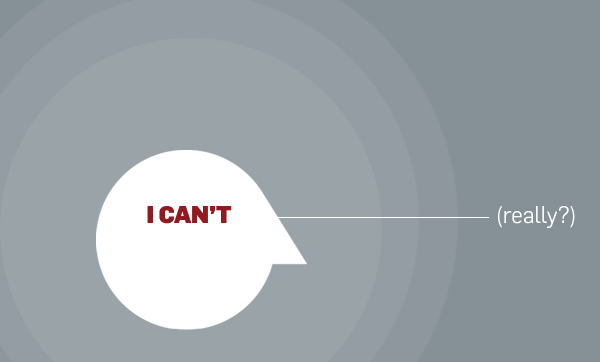
Every moment of every day, whether you realise it or not, you are surrounded by an invisible bubble.

The bubble protects you from the world outside. It keeps you safe. It helps you cope with reality, maintain a sense of normality, and manage your day-to-day business.

And it limits your potential.

The bubble is created by your beliefs - your ideas about yourself, about the world, and about reality. Many of these beliefs are useful and harmless. But some of them are misguided and limiting.

Limiting beliefs are with you at all times. But because they are so close and familiar, you don't even see them. You have forgotten they exist.

Only when you see your limiting beliefs can you truly wake up and be motivated to make a change. A wonderful thing happens when you ‘pop the bubble’ of your beliefs. You see things as they really are. Possibilities open up. You trust and take new action. You grow.

I've met people who have been victims of their own beliefs for years. They've been stuck in one place in their career and the fear of failing or not knowing what to do next keeps them from taking a risk and making a change. Generally, the sooner a person sees their limiting beliefs and starts to think differently, the better chance they have to get what they really want in life.

But just because you see your limiting beliefs and start thinking differently it doesn't mean that change and transformation will happen quickly. Each of us has a lifetime of limiting beliefs to unload and that process will take time. I promise you.

People hire me to coach them and what mainly happens in our process together is that we ‘pop’ the bubble many times, until limiting beliefs and fears disappear. Instead, they become inspired and motivated people who live their lives coming from love.

When I coach someone, a very special bond develops between us. Because we spend so many hours in deep conversation, it's sometimes hard to see immediate results as we're still inside the process.

But once in a while, at very special moments, I get to watch a person's life transform and feel the pride and joy in doing what I do. That's a big part of why I love to coach. I love the ability to wake a person up, show them their own limiting beliefs and guide them towards living a life filled with love and integrity.

One such person is Rochelle Seltzer, a powerful woman I’ve coached for a few years now.  I want to tell you why you need to know about her.

I met Rochelle while presenting a weekend seminar to a group of creative agency owners in Boston back in 2009. At the time Rochelle had been running a medium size design firm for many years. I remember how engaged Rochelle was during that workshop and how excited she was to learn from me.

Soon after that weekend, she hired me as her coach to help her grow her agency. What she didn't realize was that she hired me to help her grow herself.    

Rochelle's own limiting beliefs were getting in the way of her growth. She wasn't motivated to grow her design firm much and was feeling pretty burnt out. Her heart wasn't in it anymore. She was clueless to what she could become outside of being a designer.  She felt stuck.

It wasn't until Rochelle let go of her old beliefs and started believing in herself and her creativity that transformation started to happen.

After about a year of coaching, Rochelle decided to sell her firm and follow her heart to discover who she wanted to become. She gracefully said farewell to a career as a designer and creative agency owner, and became a student again. She slowed down her life enough to be able to listen to what her heart truly wanted. And she fell in love with coaching - and trained as a coach herself.

Today Rochelle is in a whole new place. A bigger place. A place where she is working in concert with her mind and heart. A coach and creative healer with special talents and gifts that serves our creative industry in a whole new way.

I have tremendous respect for Rochelle, for following her heart and going through the rough parts to get to where she is today. I am sure she will agree that her journey of transforming wasn't always easy, but was well worth the hard work.

This is a proud moment for a coach. A moment where I get to witness an evolution, a healing of a person, and to celebrate their contribution to the world. I'm humbled at the power of coaching and want to celebrate it with you too. I invite you to take a few minutes and visit Rochelle's website, read some of her articles and do some of the creative exercises she created for you.  

How to identify (and change) your limiting beliefs

There’s a very good chance you’ve created a limiting belief that is stopping you from doing what you think you can’t. But how can you detect that invisible bubble?

Your self awareness is key. Start listening to yourself talk, and notice where in your life you find yourself saying “I can’t…” or “I don’t know how…”

The more you catch yourself saying “I can’t”, the more you can start seeing the bubble you’ve created. And when that happens, challenge the thought.

Ask yourself: “Really? Says who?”

You may be surprised at the insight that comes up in that moment.

If you start doing the things you think believe you ‘can’t’ do and stop doing the things you believe you ‘should’ do you’ll start experiencing life on a whole new level.

What beliefs have YOU overcome?

Have you ever become aware of a limiting belief and let go of it?

What happened? What did you learn?

Found this article helpful? Sign up to my mailing list and get more ongoing advise and valuable resources on growing yourself and your creative business delivered free to your inbox.

fish.gif

Getting clients vs. enrolling clients

Getting clients will only get you more projects but enrolling clients will create programs that lead your clients to places only you can take them.

Most marketing and sales programs will teach you how to "get" clients. That's what every business owner wants, isn't it? Without clients you have no business.  A successful business requires that your attention always stays focused on "getting" the next client.  Right?

But "getting” clients feels like fishing from a leaky boat. It is very unpredictable. You cast your net hoping to catch a client while praying that the client you catch is actually a healthy one.  Meanwhile the bottom of your boat is filling with water.

I meet many agency owners who continually cut bait and cast lines desperately trying to "get" a client. Some even give their work away just to prove they are worthy to do the work. Proposals become auditions and RFPs feel like the next request for a dog and pony show.

No one wants to work like this.  And no client wants to be "caught" either.  Healthy clients want to be led, guided and served. So rather than trying to "get" your next clients, change your mindset.  Look for clients who you can enroll in working with you.

When you enroll a client the relationship shifts immediately to positioning YOU as the expert.  You become the attractive commodity the client needs, not vice versa. Your client’s thinking shifts from hiring you to engaging with you. You call the shots of how much it costs to work with you, what the results will look like and how long it takes to do your work. In other words, you get to truly lead.

The idea of "getting" anything comes from fear-based business thinking that, sadly, is rampant in our creative industry. Fear stops us from truly leading and is ultimately the core of all our business development problems. Fear based thinking is not only destructive; it’s contagious. Not only do we manufacture it ourselves, but we can catch it from others. Just attend any design conference and you can sense the fear in the room.

Getting clients is a reactive approach and reactive thinking is the hallmark of fear mode. If you are "getting” clients you have to persuade them that you are the best choice for the job and often times you have to compete for the work. Your marketing becomes reactive, desperate, and unfocused.

Fear-based sales and marketing is what most creative people know and it is the chief reason that business owners hate selling and avoid marketing. When you "get" a client, you are positioned as a vendor, someone who can be replaced at any given moment. Your fear of being replaced then causes you to work in people-pleasing mode leading to stupid decisions that ultimately cost you more than you bargained for.

So how do we get out of fear?  Fear is simply the absence of love. When you love your business, love your clients and love yourself you work from a totally different, love-based, approach to your business development and leadership. Your sales and marketing stops being about you, your accomplishments and your awards and starts being all about serving your clients and transforming their world.

 When you create programs for your clients to enroll in you become one of a kind. You show up as someone with unique expertise and a whole new playing ground for you to lead your clients into. You now have something different to offer, something unique and valuable. And oh, yeah, you also have the wherewithal to charge a lot more for your work.

Enrolling clients becomes an invitation not an audition.  Now, what you sell is not simply the outcome of your work but the experience of working with you and your unique point of view.

It's a simple distinction to remember: "getting" comes from fear; "enrolling" comes from love. Projects become programs and clients become your followers.  Bring more love into your business and create the next big program for your clients to enroll in. 


goodbye.jpg

Why I decided to leave Facebook.

Four years ago, a good friend of mine who lives in Sydney, Australia, visited me. We had not seen each other for a couple of years. We missed each other and created the time to meet and enjoy each other's company. By the end of our meeting, my friend invited me to connect with him on Facebook. "It will be a great way for us to keep in touch," he said.

I'd been reluctant to join the Facebook bandwagon for a while until that moment. But, my friend had some good persuasion skills and the next day I created an account and started inviting people I know to connect.

I had a simple rule about accepting friends, I said yes to people I knew personally and to people I have some kind of a relationship with already. Soon enough the friends counter passed the 100 mark, then 200, then 300, then 400 until it peaked at about 480. That's a lot of people to know.

Facebook is a wild frontier of online communication. There weren't really any rules on to how to use Facebook. Everyone who is on it uses it differently. It was an interesting social experiment to observe how people chose to show up in this space and what they chose to say to the world. Some use Facebook as a way to vent out frustrations, some use it to share inspiring things they find on the internet, some use it to simply jot down random thoughts or share photos of important moments in their lives.

Facebook turned me into a voyeur. There was something mysterious, exciting and most of all, addictive about this space. I was seeing parts of people's lives that I would normally see or know about and frankly, most of it wasn't so interesting to me. Little by little, I hid people from my news feed as I was tired of seeing what they ate for breakfast or another YouTube cat video. Slowly, my newsfeed became sparse and even less interesting.

But, most of all, I noticed that I wasn't really connecting to my friends like I used to. Facebook turned us into lazy friends. We didn't seek spending real time together or having a real live conversation any more because we pretty much knew everything that was going on in each other's lives already. Facebook provided an artificial sense of connection.

Earlier this year, I took a three month sabbatical and logged off Facebook for that time. It wasn't easy, but it was part of my intention to take total time off. After returning from my sabbatical, I started to reconnect with friends and clients mostly via email. We set up time to meet or talk right away. We missed each other. And when we talked, we had wonderful, deep conversations, we shared the good and bad news in our lives and we made a deep connection. I believe this was possible to achieve only because we had time to be apart from each other without Facebook keeping us connected.

Last week, I stumbled upon an article by Owen Williams titled "Leaving Facebook is the best thing I ever did." Owen asked "Take a look at your Facebook search history. When was the last time you actually had a conversation with half of those people?"

So, I did. And discovered that the number was shockingly low. Out of almost 500 people, in the past year I had a real live conversation with less than 50. And of those 50, half were my family and the rest were my close intimate friends.

It became clear that there wasn't much value or interest in staying on Facebook to maintain relationships. I much prefer putting time and effort into connecting to the people I care about the old-fashioned way. I am looking for the kind of friends who are willing to make an effort beyond "liking" something I say.

Facebook is changing from being a social network of connecting friends and loved ones to a strong marketing tool for businesses. Earlier this year, I started a professional page where I've been posting insights, news and announcements. I currently have about 130 people who are getting my posts and those are people who are part of my tribe.

I see the value of keeping Facebook as a marketing tool. For some people, Facebook is the only channel of receiving news and information. That's what Facebook has become for me. I've been "liking" pages by my favorite recording artists, brands I am interested in and people who act as good curators to things I am interested in. I'm finding it valuable to visit my Facebook page for news and information.

Un-friending people one-by-one at first brought some guilt and sadness, but the kind you get when you're leaving a party, not the relationship. I sent each of my Facebook friends a personal message explaining why I am about to unfriend them and how I plan to use Facebook in my life from now on.

Surprisingly, many of my friends responded saying "I'm thinking of doing exactly that" when they received my message. Who knows, I may be starting a trend here. Until then, I'm going to enjoy my freedom and liberation and dedicate my time to things that matter more.

How to avoid nightmare clients (and keep the good ones coming back)

Have you ever taken on a new client only to discover you’ve signed on with a nightmare? Not long after the engagement starts, you come to realize that this client needs constant attention.  They are unorganized and unprepared.  They take forever to make a decision.  They don't listen to your advice.  They try to tell you how to do your job.  You’re miserable and you’re probably losing money by keeping them around.

This is not a client problem. This is a leadership problem. There can only be one leader in your client relationship and if you aren't the one leading, your client will, and that's when it starts becoming a nightmare.

Bad clients are no fun, but they are good for business in one way. Bad clients highlight the areas that need improvement in your leadership skills. Business owners need to recognize that we are the cause for the bad clients who keep coming back, and change our business.  The more difficult a client is, the bigger the need to look in the mirror and ask why this client was attracted to you in the first place.

Your ideal client is looking for leadership, not for execution of their bad ideas. When you choose to show up as a leader, you'll start getting clients who want to be led.  But those amazing clients need to trust that you will lead them to where they want to go.  And for that trust to develop, your clients needs to know why you’re in business.

Simon Sinek, author of Start With Why, teaches: "People don't buy what you do; they buy why you do it. And what you do simply proves what you believe.” Unless you lead your business with what you believe, what you stand for and why you do it, you become just another service provider that's ready for the client to lead the way.

If you want to be a leader in your organization, you must have a clear vision of why your business exists. What's your purpose? What's your vision? What's your dream?

Many creative businesses waste time and energy on marketing activities that lead nowhere because most marketing is simply saying "look at me and how good I am" which looks needy, creepy and unattractive to your ideal clients.  Stop leading with your skills and start leading with your mission. That's when the ideal clients appear.

When I started coaching business owners years ago, I used to take on any client that had a checkbook. I figured that as long as money was coming in and I was busy, I was doing well. It didn't take too long before I started getting frustrated with my business as I was getting the wrong kind of clients. Even more frustrating, I wasn’t seeing the kind of results and change I wanted my clients to experience. 

One of my mentors told me, "It matters more where you are coming from, rather than where you are going." What he was talking about was the "why." Unless I was clear about my purpose (where I am coming from), every action I would take would be misguided and lead to bad clients and marketing that goes nowhere.  I realized that the problem started with me.  I didn't have a clear vision or purpose. I was in business to satisfy my own insecurities and fears. It was more about making money than making a difference. So, I took time to closely examine my why, connect to my purpose and show up as a true leader. And that’s when my business transformed.

If you want to be the kind of leader that your clients respect, listen to and pay well, here are a few ideas to consider: 

1. Get clear on your why.

Your purpose will be a powerful force when it's clear and defined.  Unless you are fueled by a purpose that is bigger than you and not about you, you'll keep attracting the kind of clients that only see you as a vendor and not as a leader.  When you are totally clear on your why it becomes part of what you are known for. That's a powerful way to attract amazing clients who believe in what you stand for and want to support that mission, too.

2. Tell a different story.

Your marketing is the story you tell the world, so choose to tell a story that comes from a place of expertise, knowledge and leadership. Your marketing needs to be less about the results you bring your clients and more about how you can lead them to where they want to go. Your marketing needs to always support a bigger vision that is in line with making a difference in your client's world. That's when you'll stop attracting bad clients and start getting advocates and supporters.

3. Raise your rates.

A client who says, "I can't afford you" isn't seeing your true value. That's probably because you aren't seeing it either. Clients who make their decisions based on money are acting from fear and will not be open to being led. They will want to control the process and not listen to your advice. As scary as it may sound, the best way to make bad clients go away is to charge more. If you are afraid to charge more you are probably afraid to lead your clients in other ways as well.  Leaders don’t come from fear.

4. Say "no" more often.

You probably take clients on quicker than you should. Slow down your client enrollment process and take the time to discern if the client is a good fit for you.  Don't be afraid to tell your clients how YOU work and what you are looking for in a client. By describing your ideal client to an interested prospect, you are leading them toward rising up to work with you rather than bringing you down to be seen only as a vendor.

Your best clients will come when you become a true leader.  Leaders come from love, purpose and the desire to make a difference. Leaders who know their value and believe in something that is bigger than they are will have no problems with saying no. Your best clients are waiting for you to lead them. It's up to you to make that choice.

path2.jpg

Where creative answers come from

Photo :: Sherbrooke Forest, outside Melbourne, Australia (by me)

Like a spring flower just coming up from the ground, I'm slowly emerging from a three-month sabbatical where I turned the noise down on my life, including contributing to this blog. I created a quiet space for myself with no external input (no email, no social media, no clients). As a result I got answers to several big life and career questions I’ve been asking.

Creating this quiet space was crucial to my continued growth as a coach, a creative person and as a human being. I was able to see clearly and listen to my inner voice. Some big a-ha moments happened.

All of us face big and small challenges in life and in work from time to time. And although not all of us can take three months off (it took me five years to be able to do it) the concept of quiet space can still apply in your life every day.

To get answers to our problems we can ask a friend for advice, hire a consultant, work with a coach, read a book, attend a conference or participate in a workshop. Those are all good options (I've used them all myself) but there's a closer and more immediate source that can help you figure things out - you.

You have the power and creativity to solve every one of your problems. Your inner voice knows what's best for you and if you listened to it more frequently and more carefully you would save yourself time, energy and money.

But how can we possibly hear what goes on inside of us if all we hear is noise from the outside?

We live in a culture of constant noise and opinion. Everyone has something to say and something to sell. Next time you scroll down your Facebook wall or Twitter feed, notice all the noise. Most of what you'll see is people (or companies) sharing their opinion or promoting something. It's really all about them. Noise noise noise.

I'm amazed at the solutions my coaching clients come to when they access their inner voice. But to hear that voice we must create a space where the noise is reduced and your higher self can be heard.

So how do I hear that inner voice? I take a walk.

Friedrich Nietzsche said "All truly great thoughts are conceived by walking". When Im facing a problem or whenever I find myself in a creative block, I take a walk. Staring at a computer screen searching for inspiration doesn't cut it. I need to move my body and circulate my blood so it can turn my brain ON and spark new ideas.

Walking is the universal way to solve problems. Most of us walk for the sake of getting exercise or to get from one place to another. We'll often have a pair of headphones on listening to music or a podcast, or we'll walk with a friend engaged in a conversion.

The kind of walking I am talking about is walking for the sake of walking with an intention to get present, slow down and listen.

Next time you face a tough problem, try this first: take a thirty minute walk. Leave your computer/phone behind, take no music and if possible, walk in nature. Gift yourself time and space to reduce noise so you can listen to a new voice - yours.

Start your walk by getting present. Take a few breaths and look around. Notice your landscape and connect to your surrounding. Drop your thoughts. Don't force anything. As you walk you may start thinking about your problem. This will come naturally. When thoughts come up, observe them and start asking questions like "what could I try?" or "What seems to be wrong with this situation?". Be curious. Don't expect an answer, just be in inquiry and play.

Suddenly, a path may open. Slowly, ideas may spark. You may see something new in the situation or get an idea about a different approach to the problem. It may not be THE solution but you might get an idea about where to go to get the right answer. And sometimes, of course, the answer will blossom before you like the most beautiful spring flower, waiting for you to notice.